StepControl: Long-Horizon Human Motion Generation from Foot-Contact Schedules
WACV 2027
Seoul National University

Paper (soon)
arXiv (soon)
Code (soon)
WACV 2027
Seoul National University
Controllable human motion generation has largely focused on specifying what action should occur or where the body should move. We study a complementary question: can full-body motion be controlled by specifying only when each foot contacts the ground? StepControl is an autoregressive diffusion model conditioned on a future binary left/right foot-contact schedule, without requiring target root and body poses or semantic prompts. It represents contact as explicit temporal events and injects them through dedicated cross-attention with classifier-free guidance. A stochastic mixture noise schedule and rollout warmup support stable long-horizon generation. StepControl follows prescribed contact timing over long rollouts and responds to edited schedules including cadence changes, stop-and-go pauses, limping gaits, and bilateral jumping.
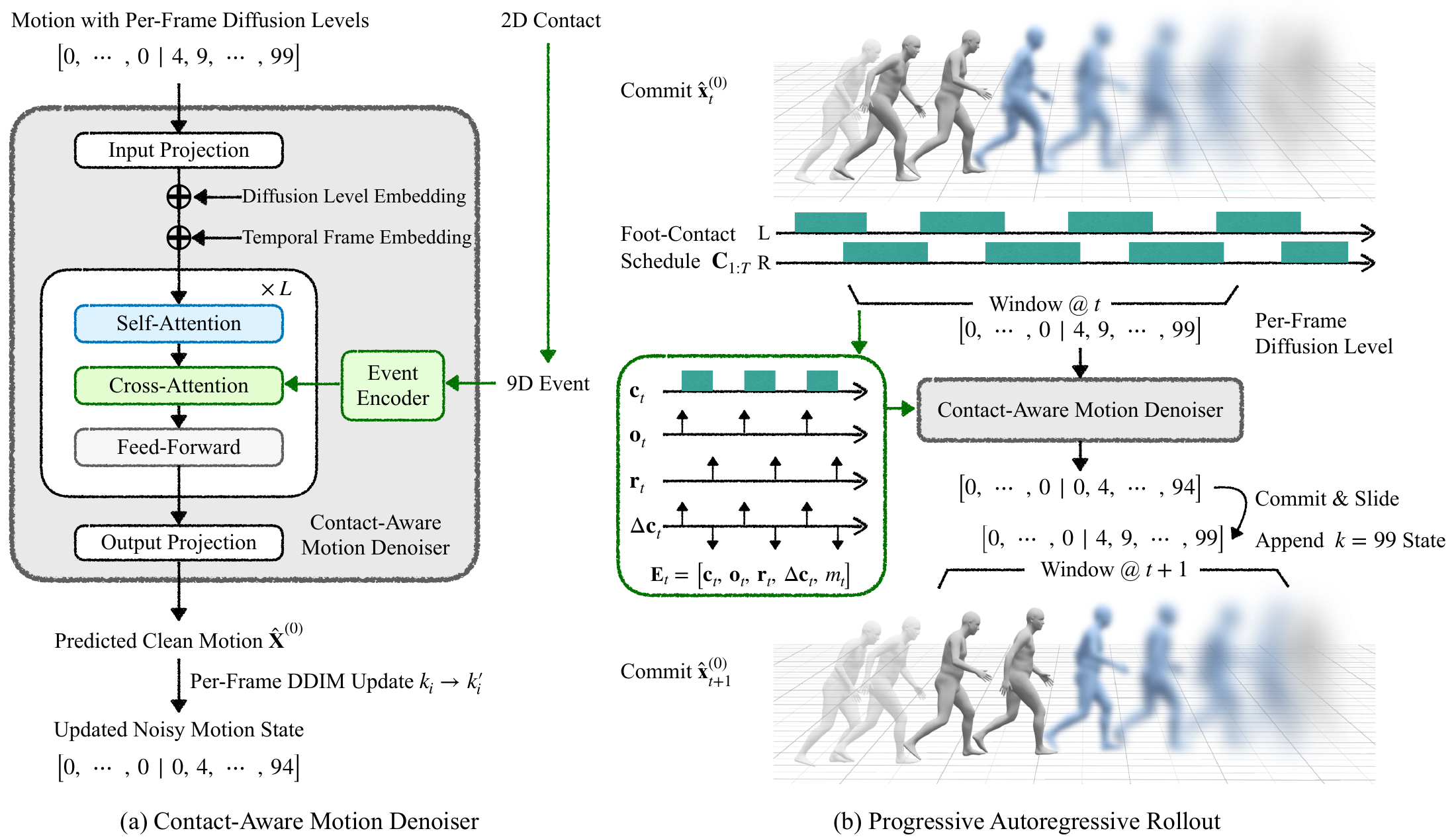
StepControl is an autoregressive diffusion model that generates motion from a short observed prefix and a future foot-contact schedule. (1) Event-aware contact: binary left/right contacts are expanded with onset, release, temporal change, and validity signals. (2) Dedicated conditioning: motion tokens attend to contact tokens at every Transformer layer, and classifier-free guidance controls adherence at inference. (3) Progressive rollout: a mixture noise schedule trains the denoiser for sliding-window generation, and a short warmup initializes the first rollout window.
We compare raw StepControl (without post-optimization) against spatial-trajectory baselines DART and ARDY, adapted to foot-contact constraints under identical timing conditioning. ARDY is visualized with its native mesh configuration.
Expressive, rhythmic contact patterns generated without text or audio guidance.
Low-frequency stepping schedule with lengthened single-stance duration.
Locomotion interleaved with standstill periods, requiring precise stance locking and resumption.
Simultaneous release, airborne phase, and coordinated two-foot landing.
Asymmetric left/right stance durations requiring non-uniform gait timing.
Continuous 20-second rollouts from short observed prefixes, comparing raw StepControl with StepControl + Opt., a lightweight stance-foot velocity correction. All StepControl motions in the baseline comparisons above are raw generations.
@inproceedings{stepcontrol2027,
  author    = {Jang, Hojun and Bae, Jinseok and Lim, Donggeun and Kim, Taesun and Jeong, Seungbin and Lee, Younghwan and Kim, Yong Seok and Kim, Young Min},
  title     = {StepControl: Long-Horizon Human Motion Generation from Foot-Contact Schedules},
  booktitle = {Proceedings of the Winter Conference on Applications of Computer Vision (WACV)},
  month     = {January},
  year      = {2027}
}